A while ago at work, a bunch of us library people were talking about our “comfort reading”; the things we read over and over again for pleasure. I mentioned that I like to re-read Peanuts comic strips (Charlie Brown, Snoopy, etc.; does everyone still know what Peanuts is? I know Charles Schulz was never happy with the title) and one of my colleagues asked me why Peanuts? (They asked nicely, with curiosity, not judgement.)
Perhaps most obviously, Peanuts is comfort reading to me because of nostalgia. I still have some of the Peanuts Parade collections I owned as a child and read over and over again–at least one of them still has the Bradlees discount store $.99 price sticker on it. I have another stack of the little spinner rack paperback collections, one of which has my uncle’s name in it so I think I basically stole it from him. I received a lot of Peanuts birthday cards and a few Christmas ornaments from my grandmother. The strip has been a part of my life for as long as I can remember.
Another of my co-workers said that Calvin and Hobbes was comfort reading, and of course I think Calvin and Hobbes is a great strip. But it doesn’t do the same thing for me as Peanuts does. I think it may be partly because I like the way Peanuts goes through a lot of variations on each idea, and I also like the bigger cast of characters.
Every Peanuts strip isn’t a banger. Charles Schulz wrote the thing every day for fifty years, so it’s not reasonable to expect that every strip will be laugh-out-loud funny. Instead, a lot of individual strips just show the characters interacting in their typical ways, sometimes setting up a bigger payoff down the line.
Because he had to produce something every day, you can see when Schulz would get an idea and not want to blow it all in one go, but instead to work out a bunch of variations of the idea over a week or more. So, for example he doesn’t often do just one strip where the kids are playing baseball. Instead he’ll do a week’s worth of strips where the kids deal with feeling like hypocrites out in the field for cheering on Charlie Brown when they really have no confidence in him as a pitcher. Or Lucy makes a kite out of Linus’s blanket and he watches it fly away.
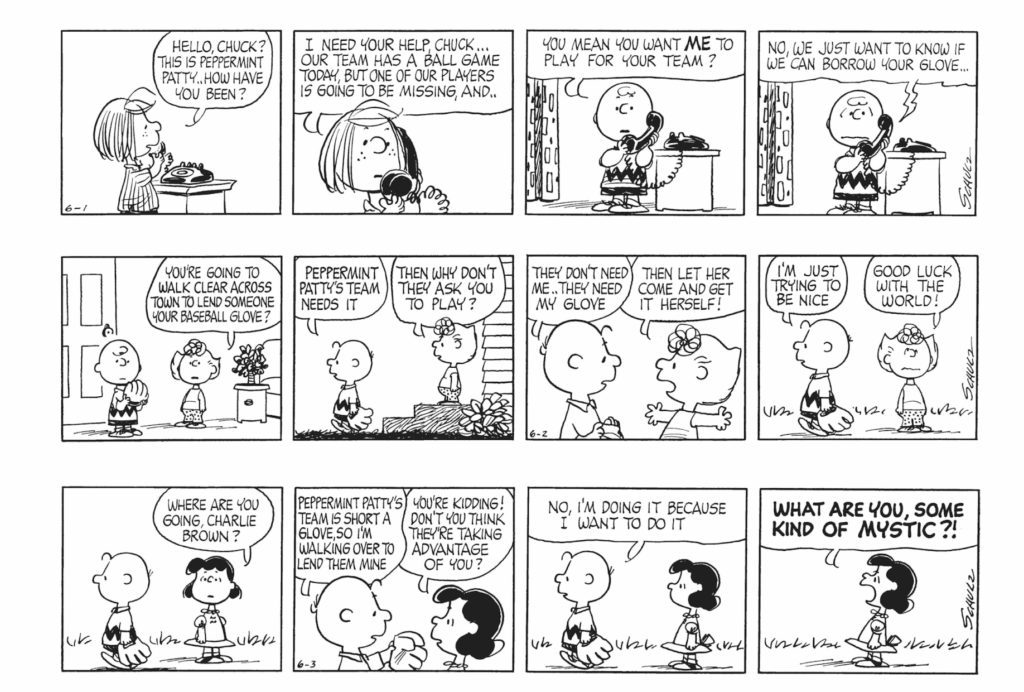
Strips from three days in June, 1970
Reading strips in a sequence like that, I feel like most rate either a “ha” or an “eh” from me. “Ha” means it’s funny, I get the joke, maybe a little smile. “Eh” means the joke didn’t land, or is too similar to another strip, or just the punchline is too topical and not so punchy after over 50 years.
But every now and then, there’s a “HA!” strip, or one that I really laugh aloud at. Sometimes they are set up well by the proceeding strips and sometimes they come out of the blue.
And every now and then there is a “damn” strip: one that’s just a little too real, one that makes me pause. There’s a whole series of strips where Lucy buries Linus’s blanket and he goes through withdrawal and psychological torment. There is this one, the fourth strip in a series where Charlie Brown’s favorite baseball player (presumably the not-yet-named Joe Shlabotnik) is sent down to the minor leagues:
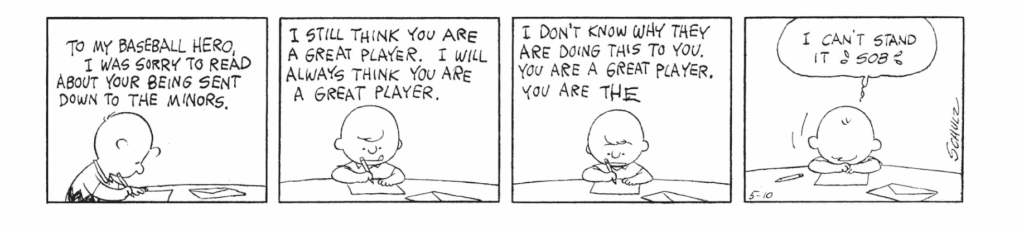
May 10, 1963
I mean, damn. What kind of punchline is that? Sometimes life just sucks and the things that you turn to for comfort, like sports (or comic strips), just make you feel sad and hollow instead.
This strip is somewhere between a “HA!” and a “damn” for me:
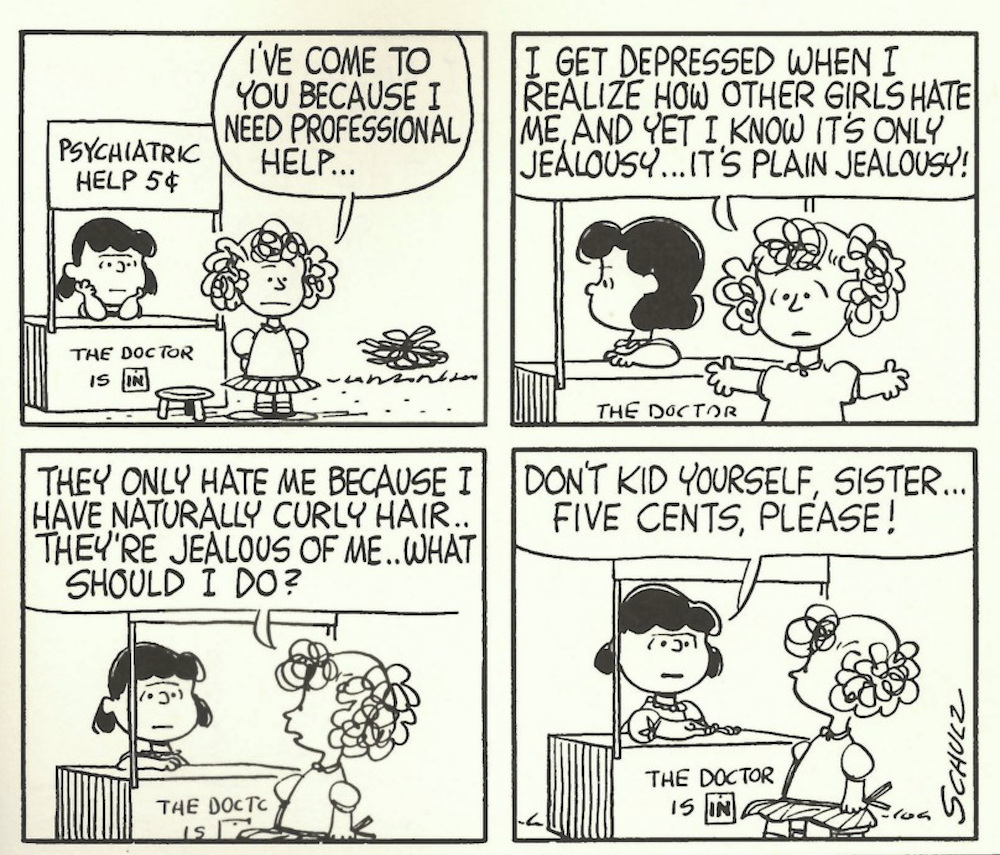
September 22, 1961
I just read (and can strongly recommend) the autobiographical comic Raised by Ghosts by Brianna Loewinsohn, and I think in this wordless passage below, where she watches a Peanuts special with her friends, Brianna is reacting to that same “damn” quality–why does Charlie Brown’s isolation and alienation from his supposed friends feel so real sometimes?
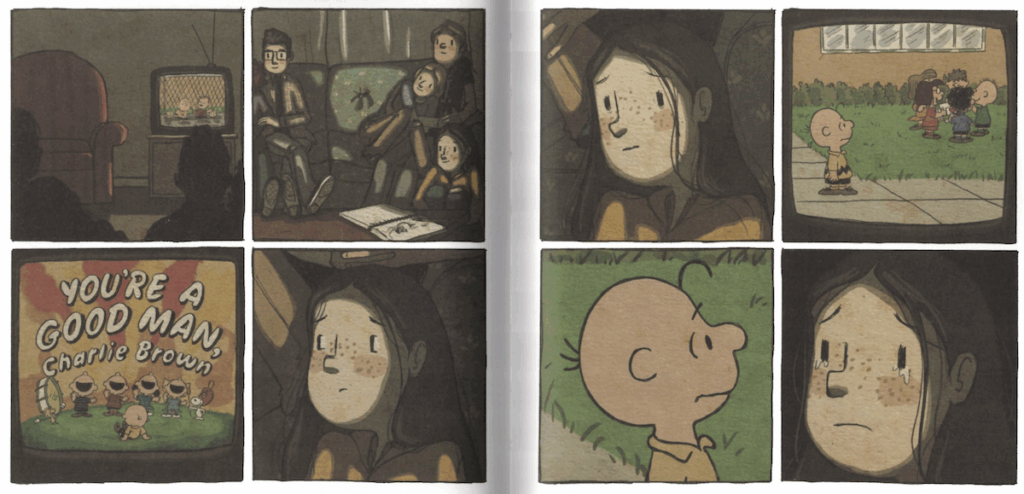
From Raised by Ghosts, Brianna Loewinsohn
Peanuts is also fun to re-read because some of the things the kids talk about were way over my head when I read them in elementary school, and sometimes that strangeness stuck in my head, and sometimes I just notice it when I come back to it. For example, I’m reading War and Peace right now, and I can relate to Linus’s approach to Russian literature.
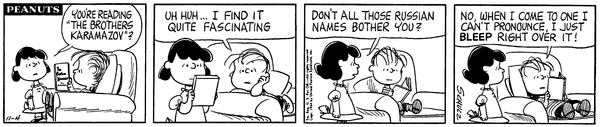
November 4, 1964
The strip below “spoiled” Citizen Kane for me many years before I saw it, and the strip below that one is a fun callback more than 20 years later.
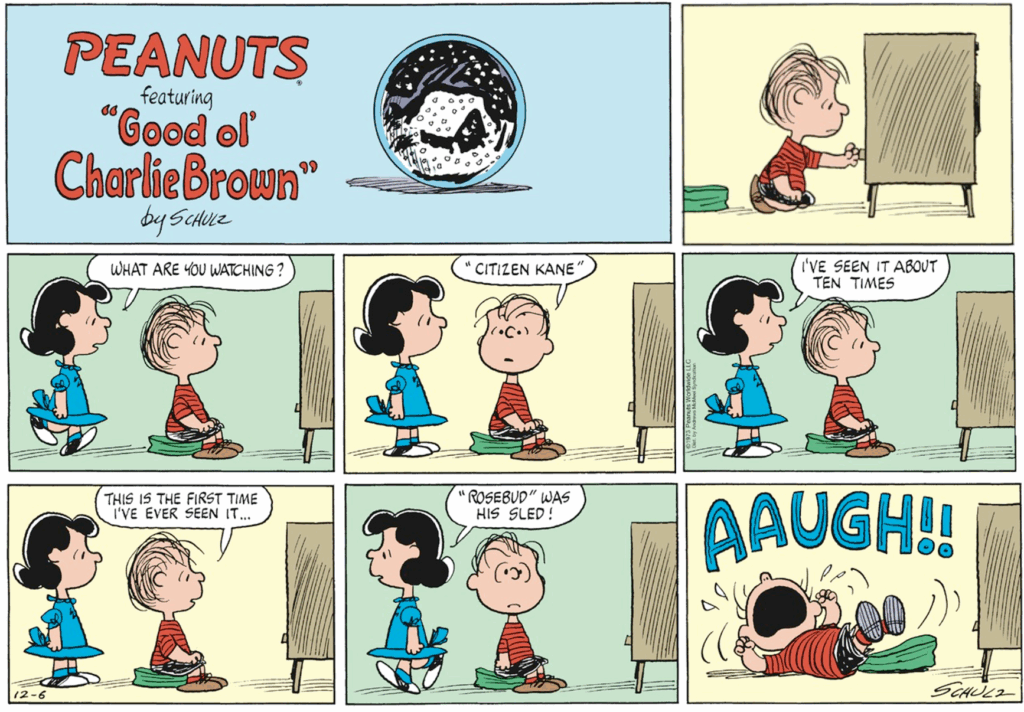
December 9, 1973
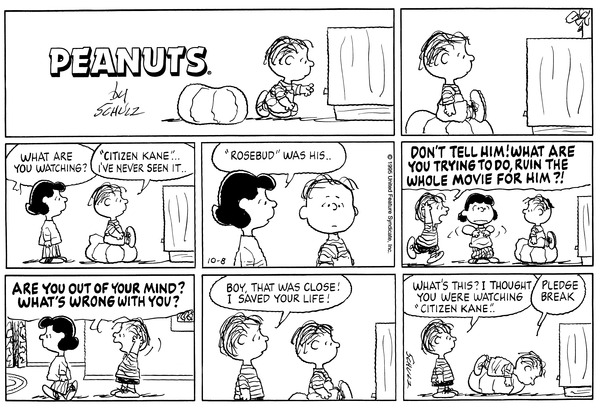
October 8, 1995
I haven’t talked much about Snoopy. I have been re-reading strips from the late 1950s and early 1960s lately and Snoopy doesn’t feature as prominently as he would in later years. He’s in his share of strips, and he’s doing improbable things like playing shortstop and worrying about his Van Gogh and his pool table. But he doesn’t start role playing as the WWI flying ace or writing pulp fiction novels until 1965. He becomes a character that allows Schulz to kind of do whatever he wants, which is great for expanding the horizons of the strip over 50 years, but often I prefer the strips that are more grounded in the daily lives of the kids.
Peppermint Patty makes her appearance in the mid 1960s and Marcie shows up in 1970 and they are two of my favorite characters. They stand outside the core Peanuts gang a bit and Patty’s straightforward can-do attitude and Marcie’s cool reserve are welcome changes of perspective. Since Patty is a tomboy and Marcie is a bit androgynous, it’s common for readers to joke about them being a lesbian couple. Liz Yerby’s mini-comic, Sir, Is This Love? is a touching treatment of that idea, with Marcie’s crush on Peppermint Patty depicted in a way similar to Charlie Brown’s crush on the Little Red-Headed Girl (or Linus’s on Miss Othmar?).
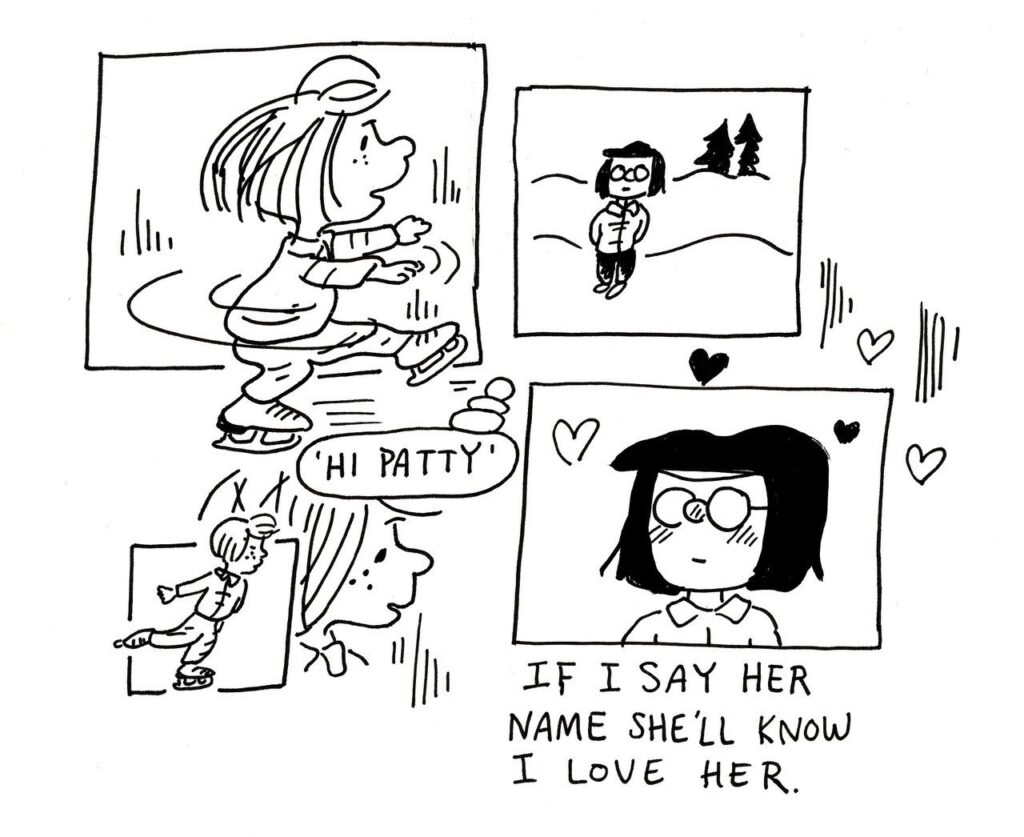
From Sir, Is This Love? by Liz Yerby
For a post about comic strip, I haven’t said anything at all about the art so far. I feel like Shulz’s art is almost unassailable, perfect like the alphabet or hieroglyphics. It’s interesting to see the work from the early 1950s before the characters reached their mature form, or the late 1990s when his line started to waver with Schulz’s age. Because for all those decades in between, Peanuts feels inevitable.
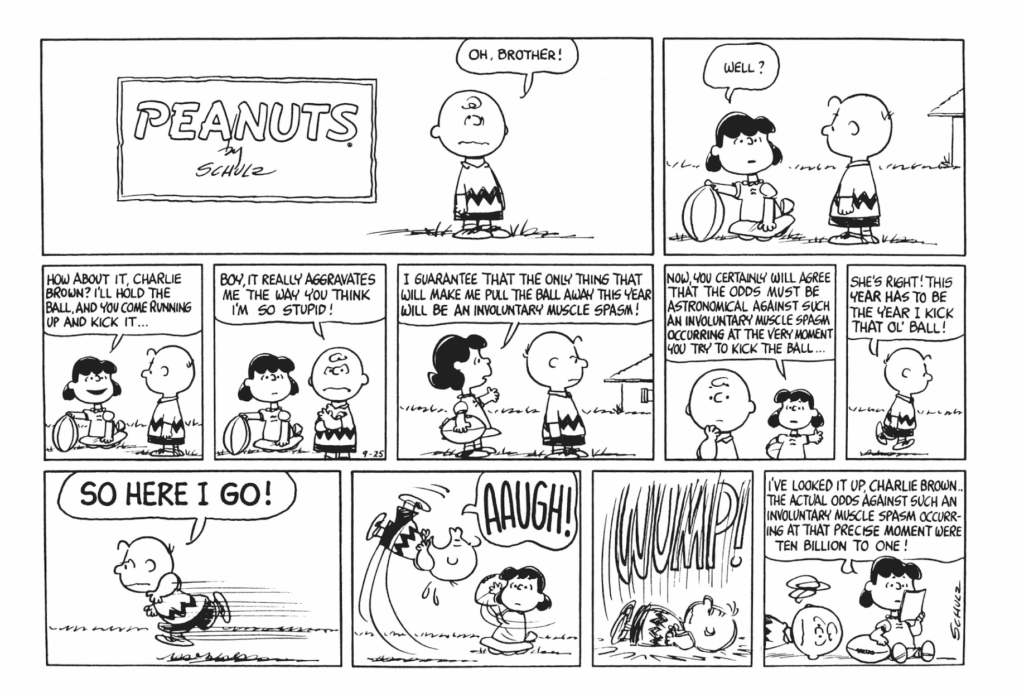
September 25, 1966
I think of all the iconic motifs and tableaus that Schulz created over the years: Snoopy lying on top of his doghouse; Charlie Brown and Lucy and the football; Charlie Brown on the pitcher’s mound; Lucy leaning on Schroder’s piano; Linus and his blanket; Lucy at her psych booth (“the doctor is in”); Snoopy as the WWI ace, or Joe Cool; Charlie Brown’s zigzag shirt. Given its longevity, prominence in popular culture, its ability to make us laugh and sometimes go “damn!”, I think Peanuts is one of the greatest works of American art and literature of the 20th century, along with being a real comfort read.
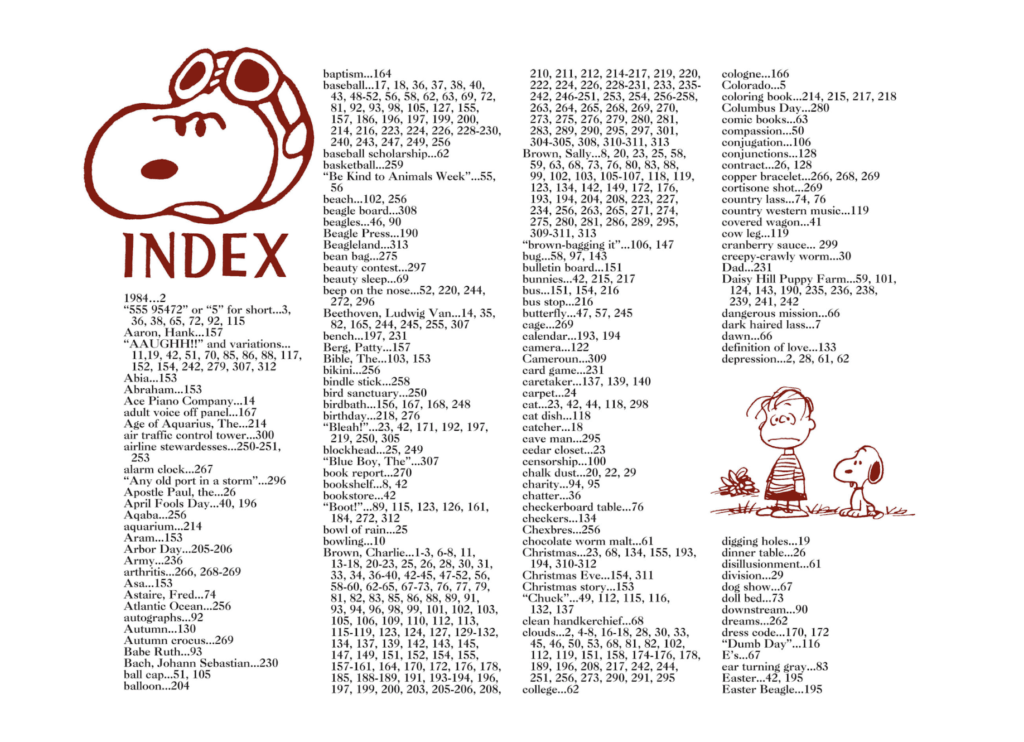
Bonus: the Complete Peanuts volumes have lovely indexes, indexing many of the words you might actually want to look up, such as “AAUGHH! and variations” and “depression” and “disillusionment” in this example from the 1969-1970 volume.


Leave a Reply