
The first I remember hearing about David Lynch and his films was from the stage of the CU Events Center in Boulder in October of 1986. Michael Stipe, lead singer for REM, was telling a story. Stipe, he told us, had worked in a nightclub that featured an Elvis impersonator. On the night that the real Elvis Presley died, the impersonator was overcome with emotion during his performance, and all the many people who had come to the club that night came to the stage to surround and touch the performer, “like ants on the ear at the start of Blue Velvet,” is how I remember him saying it. (Somewhat miraculously, you can hear Stipe tell this story in the recording of the show they played ten days later in Chicago, preserved on the Internet Archive. And people say the internet’s garbage! Sadly, on the night in Boulder when I heard him tell it, Stipe’s story was cut short by someone in the crowd screaming “ACID! FIVE HITS OF ACID!” Stipe responded, “hey, why don’t you shut the fuck up,” and the band played the next song).
I probably read more about Blue Velvet in Spin or Rolling Stone or one of the other magazines I picked up regularly. At some point I rented Blue Velvet and watched it with my friends Russ and Pat. “How did you know to rent that?” Russ asked me. We thought it was great.
David Lynch died this January. Shanon wanted to re-watch her favorite Lynch film, Mulholland Drive. After we did that, I started to think how much I liked Lynch, and how few feature films he made, and I thought that I’d watch or re-watch all his films more-or-less in the order he made them.
At this point, I have watched or re-watched the films from Eraserhead (1977) through Twin Peaks: Fire Walk With Me (1992) and all three TV seasons of Twin Peaks. Since I already watched Mulholland Drive (2001) recently, that leaves Lost Highway (1997), The Straight Story (1999), and Inland Empire (2006), none of which I have seen before.
This is the first of probably three posts that I’ll write with my thoughts on Lynch’s work. Expect spoilers, to the degree those even matter in Lynch’s films.
Eraserhead (1977)
I enjoyed re-watching Eraserhead much more than I thought I would. I remembered it as great and creepy and weird, but I forgot that it was also funny and reasonably short at about 90 minutes.
The black and white cinematography is oppressive, making Philadelphia and the interior sets feel post-apocalyptic. The sound design is incredible, contributing almost as much as the visuals to a sense of tension and dread. Jack Nance was never a particularly good actor, but his odd look and lack of affect are perfect for the role of Henry in this film.
Some of the most horrifying parts are also the funniest parts, like when the blood or whatever liquid pours out of the tiny chicken when Henry cuts into it. My favorite line is “Mother, they’re still not sure it is a baby!” Hilarious! Appalling!
The “baby” is a horrific thing that looks like an oversized bird fetus wrapped in gauze. It cries and gets sick with horrible boils or sores all over it. (“Oh, you are sick!” exclaims Henry. Appalling! Hilarious!) The Lady in the Radiator is cute and creepy as she dances and sings and eventually seems to provoke Henry to kill the baby (if it even is a baby!). The film is clearly about fear of sex and fatherhood, but it also has a weird framing device that I had forgotten about where there is a engineer figure in a moon or planet pulling gears, seemingly implying an outside force that has power over Henry and his world.
The Elephant Man (1980)
This is a Good Movie, by which I mean it is a film with serious actors giving serious performances in the service of a serious screenplay. It received eight Academy Award nominations. Sir Anthony Hopkins and Sir John Hurt are marvelous; Anne Bancroft (!) and Sir John Gielgud (!!) are in this thing.
In other words, it’s a very big step up from Eraserhead, and, aside from the black and white cinematography and the affection for / fascination with the outcast and grotesque, this film feels very different from Lynch’s debut.
Of the films I have watched so far, this one is the least “Lynchian” but the theme of exploitation is very interesting for Lynch’s work. In The Elephant Man, the extremely deformed John Merrick is rescued from a carnival freak show by Dr. Treves. Merrick, once found to be sensitive and well-spoken along with being deformed and traumatized, begins to be a different kind of curiosity on exhibit as the upper classes of London flock to meet him in order to demonstrate their tolerance and open-mindedness, something that is explicitly called out in the film by the character of the head nurse.
Lynch’s films often feature people with unusual body types; is this a sign of inclusion, or is it “othering,” a way to make his productions more uncanny by exploiting the audience’s unease with people who are different? It’s hard not to be sympathetic to Peter Dinklage’s Tito in the “dream sequence” in Tom DiCillo’s 1995 film, Living in Oblivion
It’s the same with other elements of Lunch’s films: is the violence (especially the sexual violence) merely to keep us interested and entertained, or is there something more important going on? I think it’s a question to keep asking in Lynch’s films because sometimes I think he uses sex and violence and “otherness” in ways that are complex and resonant and sometimes I fear it’s just gratuitous.
Another common Lynch motif that appears here is the stage, the proscenium, and the curtain, and the notion that what happens on stage can directly affect the characters’ lives. In Eraserhead the Lady in the Radiator is a surreal and uncanny presence. In The Elephant Man, Merrick’s encounter with the theatre is more realistic but with the same outsized “real world” effects.
Dune (1984)
The first Lynch film that I saw in an actual movie theater. (Don’t worry, David, I didn’t watch the others on my phone). I saw it before I saw Blue Velvet, but before I really thought about film directors.
My dad took me to see this. We had both read the book, Dune, and I was a big Police/Sting fan so I was looking forward to it. I don’t really remember my reaction to the movie. I believe I thought it was OK; I wanted more of the political side of the novel to be captured in the film. I think at age fourteen, I wasn’t ready to be very critical of a feature film.
Critics, however, were ready and they haaaaaaaated it. Ugly, confusing, too much exposition. Re-watching now, it’s all true. I don’t find the plot confusing today because I have recently watched the Denis Villeneuve version and re-read the book. But I can’t imagine watching this movie with no outside context.
The parts I like are probably the most grotesque, including Baron Harkonnen and his cultivated infections, and the Spacing Guild creatures in their tanks of mist and hovering through bad special effects.
There’s an alternate universe out there where either Lynch’s Dune was a huge hit, or where Lynch took George Lucas’s offer to direct Star Wars: Return of the Jedi, and where The Elephant Man won the Oscars it was nominated for, including Best Picture, Best Actor, Best Director, and Best Adapted Screenplay, and Lynch goes on to direct nothing but blockbusters and adaptations. Imagine David Lynch’s Aliens (1986),David Lynch’s The Hunt for Red October (1990), David Lynch’s Glengarry Glen Ross (1992), etc. etc.
Blue Velvet (1986)
This is the big one for me. I feel like everything really comes together in Blue Velvet and defines Lynch as a director. His major theme of the evil, grotesque underworld which lurks below a thin veneer of civilization–the roiling beetles in the suburban yard, the severed ear in the grass–snaps into focus.
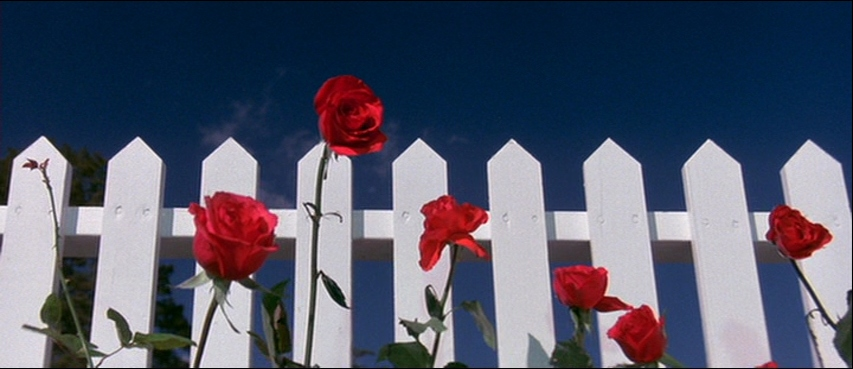
Kyle MacLachan, who I think it only OK in Dune, is just right as Jeffery, the guy who thinks that because he has a year or two of college under his belt and he wears a black shirt that he can deal with the underworld of his hometown. In the end he does, just barely.
The plot is neo-noir, but, as with most neo-noir, the plot is almost beside the point. The point is characters, the performances, and the interactions. David Lynch’s characters are rarely believable or realistic. I sort of doubt he’s ever met a real underworld figure (sometimes I wonder if he has met a real woman), but his characters have a surreal or hyperreal truth to them instead.
Dennis Hopper’s performance as Frank is over the top but I find him genuinely frightening in this role. It’s one of the all-time classic film performances in my opinion. He can be ridiculous and still have a terrible sense of menace.
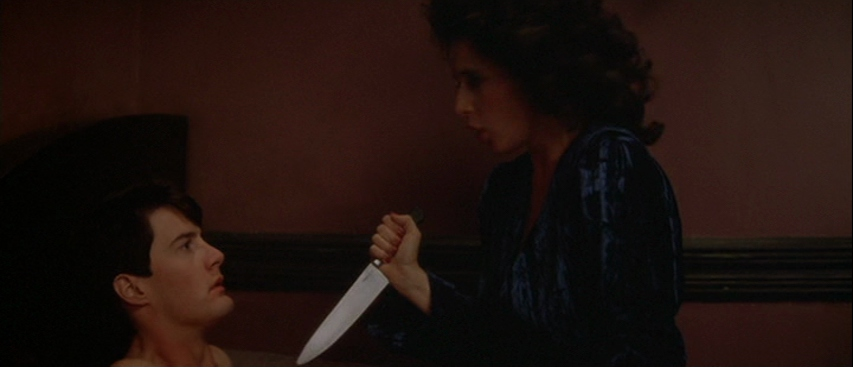
I was surprised to read that many serious critics, including Roger Ebert, wrote off Blue Velvet as egregiously, gratuitously violent. The film is terribly violent, especially in the sexual violence that Frank inflicts on Isabella Rossellini’s character, Dorothy. But I have always thought that this violence is depicted in the service of drawing in and implicating the audience and making us question our own fascination with violence. It makes us sit with how quickly and easily Jeffery goes from his concern for Dorothy after he witnesses Frank sexually assault her, to his willingness to hit her during sex when she asks him to. It’s disturbing and I can see why many people wouldn’t like the film, but I don’t think it’s exploitation. On the other hand, from this point on in Lynch’s career, he does frequently subject the women characters in his films to sexual violence or other kinds of abuse, and sometimes I do think that it is lazy or cheap. So I can understand if other people draw the line elsewhere.
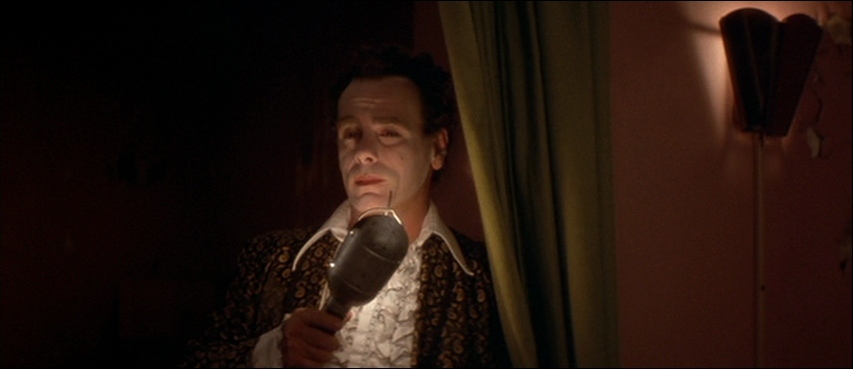
Otherwise, I think the film looks fantastic, with a great sense of color and design. Like other Lynch productions it appears to be set in a somewhat more timeless version of the present-day, where a nostalgic view of the past collides with a dismal version of the present. The themes of stage and performance return, with Dorothy’s lounge singer act, and the unforgettable lip-synch performance of Roy Orbison’s “In Dreams” by Dean Stockwell as Ben. It’s one of my favorite films, and one that I still find compelling and disturbing almost 40 years after I first watched it.
More to come
After Blue Velvet, Twin Peaks premiered on ABC in April of 1990, and Wild at Heart premiered at Cannes in May of 1990. I’m going to treat Twin Peaks–the original two seasons, the film Fire, Walk With Me, and the third “return” season–as one thing in a later post. Then I’ll finish off the films, picking up again with Wild at Heart in another post. So I hope you like reading about David Lynch stuff, and I’d love to hear your Lynch thoughts, love him or hate him.


Leave a Reply