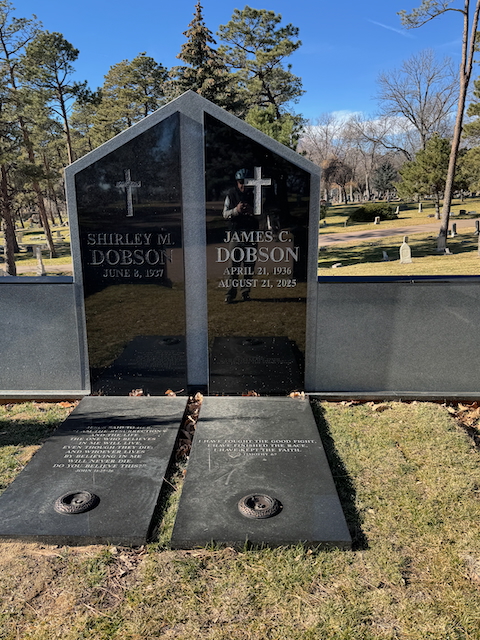
Me: I rode my bike down to the cemetery. I saw James Dobson’s grave.
Shanon: Really? Did you piss on it?
Me: I was afraid I would get caught so I just spit on it.
Shanon: Good job.
Evergreen Cemetery is a quick bike ride from our house, and I go there with some frequency. It’s quiet and pretty. I like to visit the Union Printers there and imagine their lives and their work.
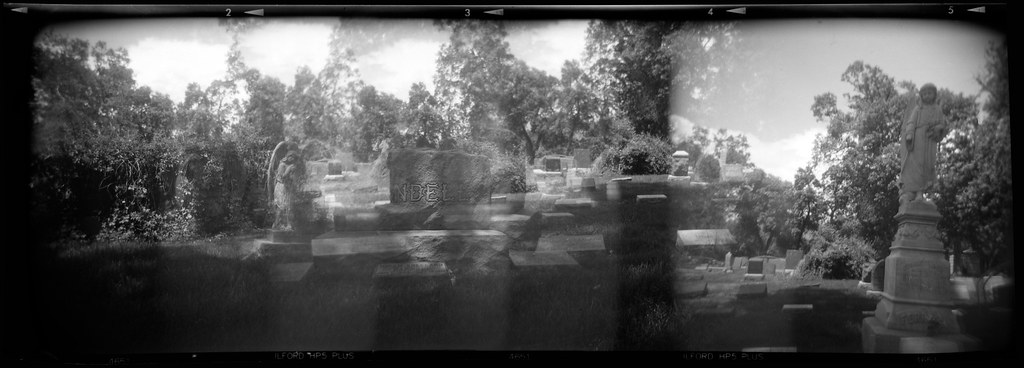
I bike around slowly most days when I visit. I often bring a camera with me, or at least my phone. Like sunsets, I think that cemetery photos are something of a cliche. Lois Connor’s first three “Rules for students in Introduction to Photography” (as reproduced in The Photographer’s Playbook) are:
- Don’t drop your camera.
- Make sure the film winds.
- Avoid graveyards, campus arches, the Manhattan skyline from New Jersey.
That seems pretty fundamental. But I break that rule a lot.
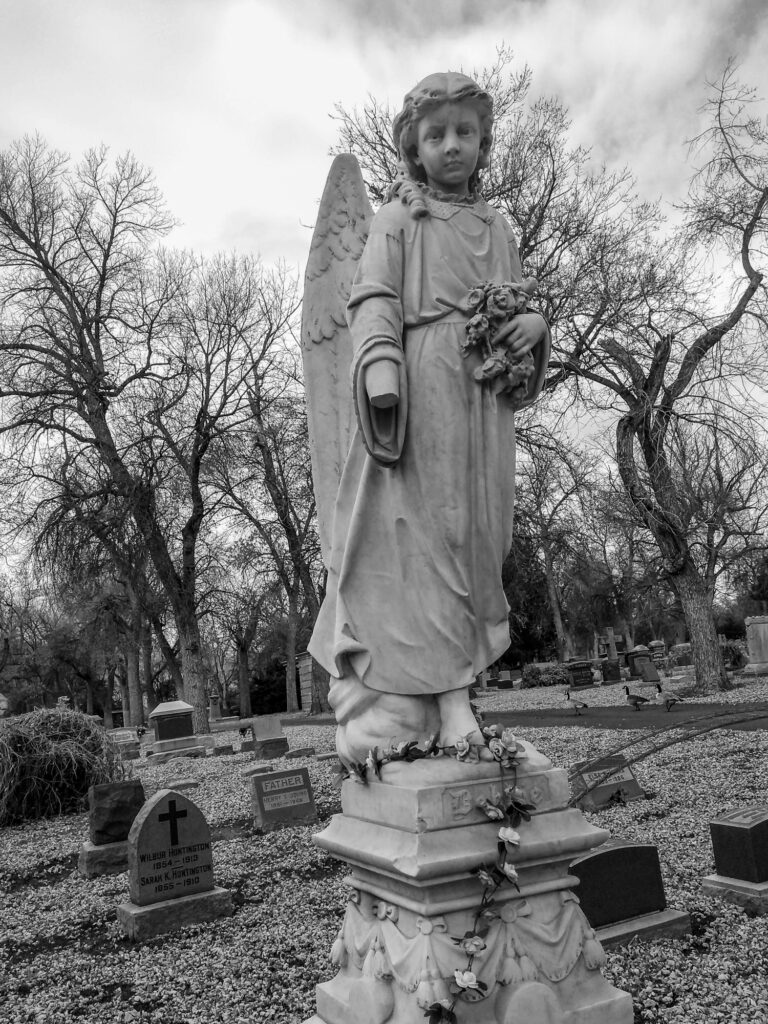
I’m drawn to this statue of Debbie. Deborah Tufts Ferrand, born 5 February 1882, died 23 April 1890, age eight, of measles. According to the Find a Grave site, her father sent a photograph to an artist in Italy to create this likeness of her as an angel. I read elsewhere that her missing right hand is due to vandalism, rather than age or accident. I think she looks lovely just as she is.
I found James Dobson’s grave by chance. I was riding slowly around the cemetery, thinking about the simple graves and the elaborate tombs, when I saw some maybe three foot high gray walls, topped with black. Seen from the back, they were bare and somewhat ugly, like a gothic above-ground swimming pool.
I went to see what wealthy person was buried there and it was Dobson, who had died just a few months ago. If you don’t know who he was, he was the founder of Focus on the Family, the right-wing evangelical anti-LGBTQ+ hate group. Searching for remembrances of him on the web, it’s quite easy to find quotes like this, from Timothy Schraeder Rodriguez in “Dr. James Dobson’s death ends a life, but not a legacy of lies and harm” published in National Catholic Reporter:
For teenagers like me in the audience, those conferences planted shame deep in our hearts and convinced us God could not love us as we were. I would spend eight years in conversion therapy, chasing a false promise that only deepened my shame.
and this, by J. R. deVries in “James Dobson Ruined My Mother’s Life: A poisonous messenger who offered an imagined Christian world” published in Commonweal.
As the decades passed, Dobson grew more political. My mother succumbed to his culture of fear—of liberals and secular humanists, of feminists and reproductive-rights activists, of Muslims and new immigrants, and of course, anything related to LGBTQ+ rights.
This was a man who spent his time on earth setting the stage for other shitheels like Charlie Kirk and for our overall Christofascist American government. The only sad thing about his death is that it didn’t come much sooner. I don’t believe in Hell because I’m an atheist, and I wouldn’t wish someone an eternity in Hell because that’s an awfully long time. But I can wish for a very long Purgatory for Dobson, until he understands all the pain and suffering he caused.
Sometimes when I’m judgemental or uncharitable, I think “Mr. Rogers would be disappointed in me.” I don’t believe in God or Hell or Purgatory, but I do believe in Mr. Rogers. I’m sure Mr. Rogers wouldn’t approve of me spitting on Dobson’s grave. But, as someone whose ministry was focused on empathy and love, I’m also sure that Mr. Rogers wouldn’t approve of Dobson either. I can live with that.


Leave a Reply