Lucy the cat
Last time I posted, we’d just lost our cat, Loki. About a month after his death we adopted a kitten whom we have named Lucy.
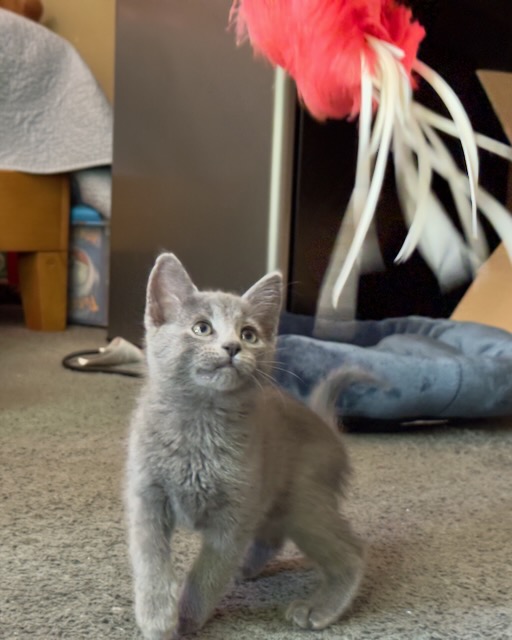
In retrospect, we may have may have named too many people and animals names that start with an “L” (Luke, Luna, Loki, and now Lucy), so we are accidentally calling Lucy “Loki” with some frequency. But the name seems to suit her, and it’s our problem to sort it out, not hers.
She was ever so small when we got her, not quite two pounds. We were able to keep her in Nick’s room for a few weeks, but before long she was demanding the run of the house, which she now has.
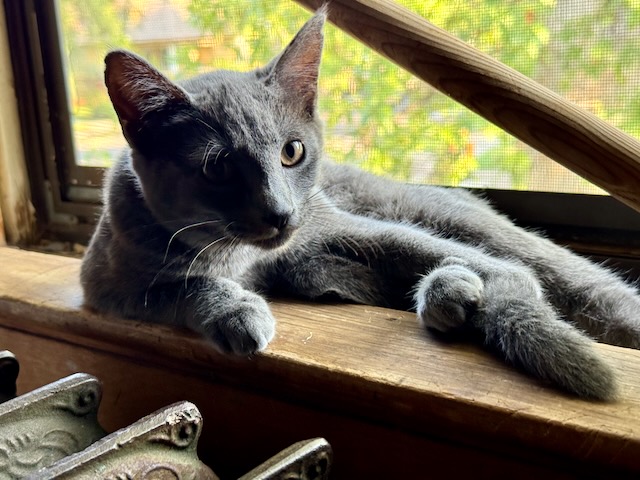
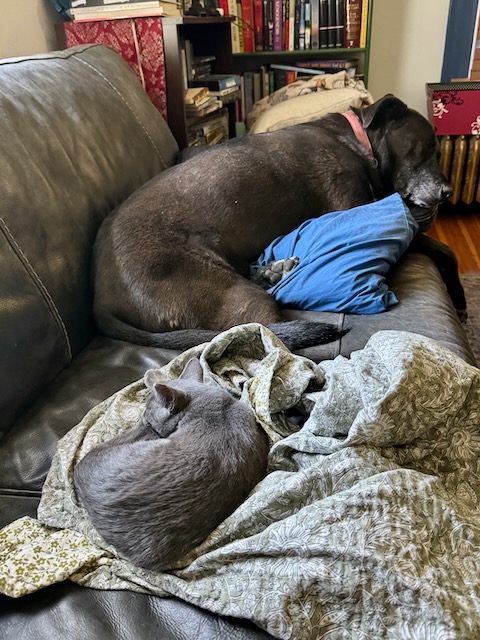
She’s growing nicely, four pounds now. She’s starting to learn that scratching and biting hurts us and makes us stop playing or snuggling with her. She and Rickert started off pretty rough with a lot of hissing on her part. Every day they seem to get a little more used to one another and skirmishes are less frequent and more quickly over. Today they were even able to ignore each other and nap together on the couch.
Summer school
I took two book-related classes this summer, paid for courtesy of the CC History Department, where I sometimes teach History & Future of the Book with friend of the blog Jessy.
Online through Rare Book School I took The Photographic Book Since 1843, taught by Richard Ovendon who has the best job title in librarianship, “Bodley’s Librarian” aka the chief librarian at the Bodleian Library, Oxford. It was a lecture and show & tell class and the collections of the Bodleian were an unreal resource for such a course. We got to see the Bodleian copies of some of the first ever photographic books, such as Anna Atkins’ British Algae and William Henry Fox Talbot’s The Pencil of Nature as well as many more excellent examples of later printing technology and art.
Then I took another online class, this time with Jessy as a fellow student. We took Imaginary Books: The Book as Performancewith Amaranth Borsuk through the Center for Book Arts in NYC. Here’s a quick description:
This workshop invites participants to consider the question “What is a book?” Taking our cue from the artists of Fluxus, participants in this workshop will collaboratively create a series of event scores—short, instruction-based artworks—based on imaginary books of their own devising, as simple or outlandish as their heart desires. In this way, we will turn the creative process itself into an artistic practice and event, generating books as intimate performances we gift to one another.
This was a very fun class, and I enjoyed getting a chance to work with Borsuk; she’s the author of the textbook that Jessy and I assign, a book that I like very much because of the way it incorporates all the things we want to discuss in our class such as the history of the book in Europe and the US, non-codex forms of the book, and the present and future efforts of people to redefine “the book” through artists books and electronic books.
In this class, I made a book from a score or prompt which was written by one of my classmates: “a book that captures the feeling of love felt by those no longer on earth.” It includes photos I took in Evergreen Cemetery from the point of view of the headstones, including the names and dates for the headstones on the facing page.
The class really got Jessy and me in the mood to make more books! I think we will also incorporate some of the assignments and ideas from the course in our future classes, too.


Leave a Reply